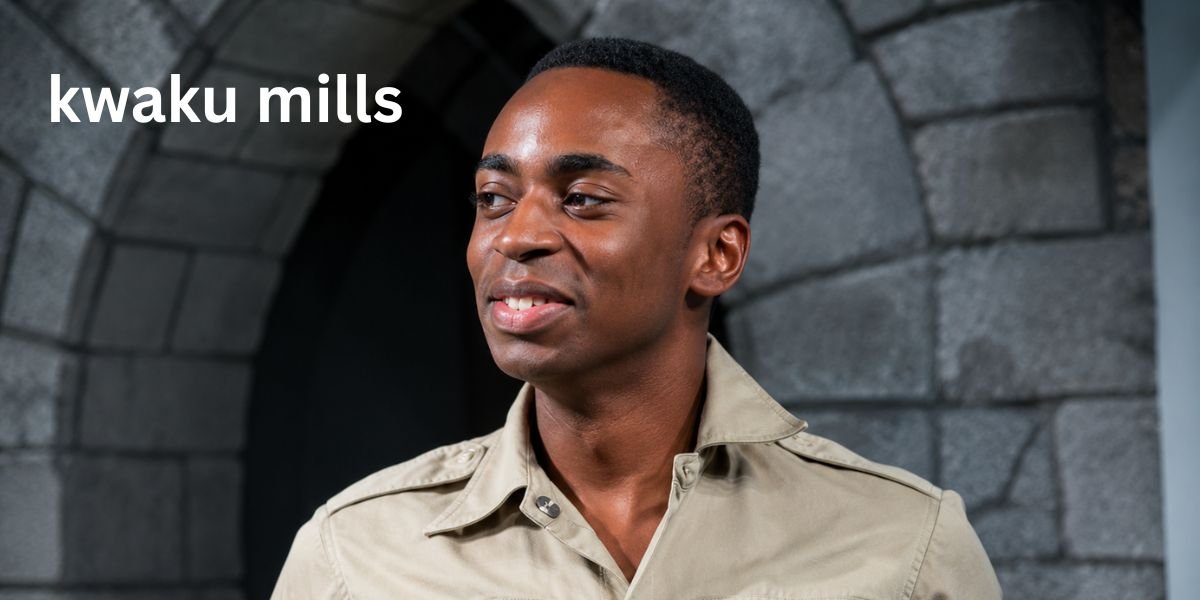
Who Is Kwaku Mills?
Kwaku Mills is a London-raised actor who has developed an impressive career across theatre, television and film. Instead of becoming known through one sudden viral role, he has gradually built his reputation by appearing in demanding productions and working with respected organisations such as the Royal Shakespeare Company, Shakespeare’s Globe, the National Theatre and Hampstead Theatre.
Television viewers may recognise him as Clark in the second series of the Disney+ comedy Extraordinary. Theatre audiences, however, are more likely to know him from productions such as King Lear, Good Dog, Edward II, Underdog: The Other Other Brontë and Wendy & Peter Pan. His professional credits show that he has successfully moved between contemporary comedy, classical drama, touring theatre and independent film.
What makes Mills particularly interesting is the variety within his acting work. His career includes Shakespeare, modern social drama, comedy, historical theatre and family entertainment. That range suggests he is not interested in being restricted to one character type. He appears to choose projects that allow him to explore different forms of storytelling while continuing to improve his technique.
Early Life and Education
Publicly available interviews indicate that Kwaku Mills grew up in London. He later attended the University of Warwick, where he studied English Literature and became closely involved in the university’s active drama community. Mills has spoken positively about feeling welcomed at Warwick and finding a supportive group of people who encouraged his interest in performance.
Studying English Literature provided him with a valuable academic foundation for the kind of acting career he would later build. Literature students regularly analyse language, structure, themes, character development and the intentions behind a text. These skills are especially useful in classical theatre, where an actor must understand complicated writing before communicating it naturally to an audience.
His participation in student theatre also appears to have played an important role in his development. Mills recalled auditioning for a production called Wonderland during his first weeks at Warwick and performing as the Cheshire Cat. He has explained that his experiences within Warwick’s theatre community helped him imagine a professional future in the industry.
After graduating, however, Mills did not immediately enter drama school. He initially accepted a job in advertising before reconsidering the direction of his career. The confidence he had developed through student drama remained with him, eventually encouraging him to apply to the Royal Academy of Dramatic Art.
Training at RADA and Entering the Acting Industry
Kwaku Mills trained at the Royal Academy of Dramatic Art, commonly known as RADA. According to the academy’s official graduate profile, he completed its BA in Acting programme and graduated in 2018. This formal training helped prepare him for the vocal, physical and emotional demands of a professional acting career.
Training at a major drama school involves much more than learning how to memorise and deliver lines. Actors must develop control over their voices and bodies, analyse scripts, respond to direction and create believable characters. They also need the stamina to maintain consistent performances throughout rehearsals and extended theatre runs.
Mills’ career following graduation indicates that he was able to apply this training across several different performance environments. His professional theatre credits include Perspective, Hay Fever, Candida, Dark Sublime, Good Dog, The End of Eddy and The Art of Illusion. These productions required different acting styles, giving him valuable experience before he began receiving wider attention.
This variety was significant during the early stages of his career. By moving between new writing, touring productions, classical texts and ensemble work, Mills avoided becoming predictable. He also demonstrated that he could adapt to different directors, performance spaces and creative methods.
Breakthrough Theatre Work in Good Dog and The End of Eddy
One of Kwaku Mills ’ most notable early roles was the lead character, known as Boy, in Good Dog. Written by Arinzé Kene and directed by Natalie Ibu, the production played at Watford Palace Theatre before touring the United Kingdom. Carrying the lead role in a touring production placed a considerable amount of responsibility on Mills as a developing actor.
A performance of this kind requires more than technical confidence. The central actor must control the rhythm of the story, create a convincing world and maintain the audience’s attention for an extended period. Touring also requires consistency because the performer must adjust to different venues while protecting the emotional and physical quality of the production.
Good Dog explores childhood observation, neighbourhood relationships, social pressure and the changes experienced within a community. Material like this demands careful movement between humour, warmth, frustration and seriousness. Mills’ role helped demonstrate that he could manage emotionally layered storytelling without making the performance feel forced.
He also played Eddy in The End of Eddy, a stage adaptation based on Édouard Louis’s autobiographical novel. The production was presented at the Unicorn Theatre and toured the United Kingdom. Its story examines identity, class, exclusion and the pressures experienced by a young person growing up in a difficult environment.
Working on such personal material likely strengthened Mills’ ability to approach serious subjects with control and sensitivity. Rather than depending on spectacle, productions like The End of Eddy require actors to form a direct connection with the audience. This experience became an important part of the foundation for his later classical and contemporary roles.
Kwaku Mills in King Lear
In 2022, Kwaku Mills played Edgar in a major production of King Lear at Shakespeare’s Globe. Edgar is one of the play’s most demanding younger characters because he experiences betrayal, displacement and a dramatic change in identity. The performer must guide the character from relative security into vulnerability and eventually towards greater courage and determination.
Performing at Shakespeare’s Globe also presents specific technical challenges. Its open auditorium creates a direct relationship between actors and audience members. Performers need strong vocal clarity, physical confidence and a detailed understanding of Shakespeare’s language because they cannot rely on camera close-ups or highly controlled cinematic techniques.
Mills appeared in a production directed by Helena Kaut-Howson, with Kathryn Hunter playing King Lear and Michelle Terry appearing as Cordelia and the Fool. The Globe described the production as a new interpretation of Shakespeare’s family tragedy, exploring power, ageing, betrayal and the human need for compassion.
His performance as Edgar received positive critical attention. Reviews highlighted the way he developed the character from weakness towards resolve and praised his ability to move from a bookish young man into someone forced to disguise himself before eventually becoming more determined. These responses suggested that Mills had successfully handled both the language and complicated emotional development of the role.
Playing Edgar represented an important milestone in his career. It proved that he could take on a substantial Shakespearean character at one of the world’s best-known classical theatres. It also made it easier to see why he would later be selected for another major early modern play with the Royal Shakespeare Company.
Expanding into Television and Film
Although theatre remains central to Kwaku Mills’ professional story, he has also developed a growing screen career. His television credits include Urban Myths: The Trial of Joan Collins, The Other One, I Hate You and the second series of Extraordinary. These productions allowed him to work within comedy and comedy-drama, using a more conversational performance style than audiences normally see in classical theatre.
In Urban Myths: The Trial of Joan Collins, Mills played Simon. He later appeared as Eric in the second series of the BBC comedy The Other One and as Philip in the Channel 4 series I Hate You. Although these were not all leading roles, they provided useful screen experience and helped him develop a broader professional résumé.
His most recognisable television work to date is his performance as Clark in the second series of Extraordinary. The Disney+ comedy takes place in a world where almost everyone develops a special power. However, much of its appeal comes from uncomfortable relationships, personal insecurity and the ordinary problems faced by its characters.
A series with such an unusual setting needs performers who can make unrealistic situations feel emotionally believable. Comedy also depends heavily on timing, listening and reacting naturally to other actors. Mills’ appearance in the series introduced his work to viewers who may not regularly attend theatre productions.
He has also appeared as Matt in the film The Trouble with Jessica. Film acting requires performers to adjust their technique because the camera can capture extremely small expressions and changes in behaviour. Mills’ ability to move between stage, television and film suggests that he understands how to modify the scale of his performance while keeping the character convincing.
Work with the National Theatre
In 2024, Kwaku Mills appeared in Underdog: The Other Other Brontë, a National Theatre and Northern Stage co-production written by Sarah Gordon and directed by Natalie Ibu. The production opened at the National Theatre’s Dorfman Theatre in March 2024 and completed a run of 65 performances.
Mills played several parts within the production, including Tabby, Cunliffe and ensemble roles. Multi-role performances require an actor to create immediate differences between characters. Changes in posture, rhythm, vocal quality and movement must be clear enough for the audience to understand without slowing down the story.
The production explored the story of the Brontë family, particularly the relationship between Charlotte and Emily Brontë. Rather than simply presenting a traditional historical biography, it examined competition, authorship, ambition and the way literary history decides whose voices receive the most attention.
For Mills, the project represented another opportunity to work with Natalie Ibu after their collaboration on Good Dog. Returning to work with the same director can be professionally valuable because an existing creative relationship allows both people to build on their previous experience.
Appearing at the National Theatre also strengthened Kwaku Mills’ position within British theatre. The production required historical storytelling, character switching and detailed ensemble work, adding another set of skills to an already varied career.
Joining the Royal Shakespeare Company
Kwaku Mills made his Royal Shakespeare Company debut in 2025, playing Baldock in Christopher Marlowe’s Edward II. Directed by Daniel Raggett, the production ran at the Swan Theatre in Stratford-upon-Avon from 21 February until 5 April 2025.
Baldock is connected to the political struggle surrounding King Edward II and his relationship with Gaveston. The play brings together questions of love, authority, loyalty and the ability of powerful institutions to resist change. Mills joined a cast that included Daniel Evans, Eloka Ivo, Ruta Gedmintas and Enzo Cilenti.
During rehearsals, Mills spoke about the importance of making a play written hundreds of years ago feel contemporary and fresh. He also explained that rehearsals were one of his favourite parts of the theatrical process. These comments provide useful insight into an acting method based on exploration, collaboration and discovering new possibilities within an established text.
Later in 2025, Mills returned to the RSC as Michael Darling in Wendy & Peter Pan. Directed by Jonathan Munby, the production played at London’s Barbican Theatre from 21 October until 22 November 2025. The cast also included Toby Stephens as Captain Hook and Mr Darling, Hannah Saxby as Wendy and Daniel Krikler as Peter Pan.
The production added family entertainment and physical storytelling to Mills’ résumé. Moving from Marlowe’s political tragedy to an imaginative retelling of Peter Pan within the same year demonstrated considerable versatility. It also showed that the RSC trusted him to contribute to two productions with very different audiences, styles and emotional requirements.
Kwaku Mills’ Acting Style and Professional Strengths
It is difficult to define an actor’s complete style from public credits alone. However, Kwaku Mills’ body of work suggests that one of his main strengths is his ability to handle text-heavy material. Productions such as King Lear, Edward II, Candida and The Art of Illusion require careful listening, vocal control and an understanding of how language creates character.
He has also demonstrated considerable flexibility. Some actors build careers around one familiar personality or character type, but Mills’ résumé does not follow that pattern. He has performed as a Shakespearean nobleman, a young observer of community life, a figure within a historical drama and a character in a modern television comedy.
Another strength is his experience with both leading and ensemble responsibilities. A leading performer must carry the emotional direction of a story, while an ensemble actor needs to support the production without competing unnecessarily for attention. Mills has worked successfully in both positions, from leading Good Dog to performing multiple characters in Underdog.
His career also shows a useful balance between discipline and playfulness. Classical theatre demands careful structure and respect for language, while comedy requires speed, timing and spontaneity. Moving between Shakespeare’s Globe and a series such as Extraordinary suggests that Mills can work within a script’s structure while still making his characters feel natural and unpredictable.
Most importantly, he appears willing to continue challenging himself. His credits do not show an actor repeating the same successful idea. Instead, each major production adds something different, whether that is classical language, multi-role performance, screen comedy or large-scale family theatre.
Kwaku Mills’ Personal Life and Public Information
Kwaku Mills appears to maintain a clear separation between his professional work and private life. The official profiles reviewed for this article focus on his acting education, theatre productions, television roles and film credits. They do not provide a confirmed date of birth, detailed family background, relationship status or verified net-worth figure.
This absence of information should not be treated as a mystery that needs to be filled with assumptions. Many working actors choose to make their performances public while keeping their personal relationships and finances private. In Mills’ case, the most useful and reliable information concerns his journey from university drama to RADA and major professional productions.
Readers searching for information about Kwaku Mills’ age, wife, partner or earnings should therefore be cautious. Celebrity websites sometimes publish estimates without explaining where the information came from. Unless Mills, his representatives or another reliable source confirms these details, including them in a biography would risk spreading inaccurate information.
His relatively private public profile may also help keep attention on the quality of his work. Audiences are encouraged to discuss his performances, characters and creative development rather than unrelated personal speculation.
For an actor whose reputation is still expanding, this professional focus makes sense. His stage and screen work already provides enough material for a meaningful discussion of his career without relying on gossip or unsupported claims.
Why Kwaku Mills Is an Actor to Watch
Kwaku Mills is worth watching because his career is developing in several directions at the same time. He has shown that he can lead demanding theatre, perform Shakespeare, contribute to ensemble productions and appear naturally in contemporary television comedy. This range gives him several possible career paths rather than limiting his future to one genre.
His work with the National Theatre, Shakespeare’s Globe and the Royal Shakespeare Company has also placed him in environments where actors are expected to keep developing. These organisations regularly require performers to combine technical discipline with bold interpretation. Being selected for their productions suggests that directors recognise both his ability and professional reliability.
Another encouraging feature of his career is its steady progression. He moved from university theatre and professional training into touring productions, established London venues, streaming television and major classical companies. This kind of progress is usually built through preparation, consistency and positive working relationships rather than temporary publicity.
His future could involve larger television roles, more substantial film work, further classical theatre or new plays developed around his strengths. However, future projects should not be assumed until they are officially announced.
What is already clear is Kwaku Mills has created a strong professional foundation. He possesses classical experience, contemporary screen credits and the ability to work within both leading and supporting roles. Those qualities make him a valuable performer in an industry where adaptability is increasingly important.
Frequently Asked Questions About Kwaku Mills
Who Is Kwaku Mills?
Kwaku Mills is a British actor known for working across theatre, television and film. He has appeared in productions created by respected organisations such as the Royal Shakespeare Company, Shakespeare’s Globe, the National Theatre and Hampstead Theatre.
His acting career includes classical plays, contemporary drama and television comedy. Some of his recognised projects include King Lear, Edward II, Good Dog, Extraordinary and Underdog: The Other Other Brontë.
Where Is Kwaku Mills From?
Kwaku Mills was raised in London, England. His London background introduced him to a diverse cultural and creative environment, which may have supported his interest in literature, performance and storytelling.
He later attended the University of Warwick, where he studied English Literature and participated in student theatre. His university experience helped him recognise that acting could become a serious professional career.
Where Did Kwaku Mills Study Acting?
Kwaku Mills received professional acting training at the Royal Academy of Dramatic Art, widely known as RADA. He completed the academy’s BA in Acting programme and graduated in 2018.
RADA is recognised for providing intensive training in voice, movement, character development and script analysis. This training prepared Mills to work in both classical theatre and modern screen productions.
What Television Shows Has Kwaku Mills Appeared In?
Kwaku Mills has appeared in several television programmes, including Extraordinary, The Other One, I Hate You and Urban Myths: The Trial of Joan Collins. His role as Clark in the second series of Extraordinary introduced him to a wider streaming audience.
His television work is mostly connected to comedy and comedy-drama. These roles have allowed him to demonstrate natural delivery, strong timing and the ability to make unusual situations feel believable.
What Is Kwaku Mills Best Known For?
Kwaku Mills is particularly known for his theatre career and his ability to perform both classical and contemporary material. His performance as Edgar in Shakespeare’s King Lear at Shakespeare’s Globe was an important milestone in his professional journey.
He is also known for playing Baldock in the Royal Shakespeare Company’s production of Edward II. Television audiences may recognise him more easily from his performance as Clark in the Disney+ series Extraordinary.
What Role Did Kwaku Mills Play in Extraordinary?
Kwaku Mills played Clark in the second series of Extraordinary. The comedy series is set in a world where most people develop a special power, although its stories are largely focused on relationships, personal struggles and everyday insecurities.
His participation in the show strengthened his screen profile and helped his work reach viewers outside the theatre industry. The role also demonstrated his ability to adapt his performance style for fast-moving television comedy.
Conclusion
Kwaku Mills has built a thoughtful career combining professional training, demanding theatre experience and growing screen recognition. From studying English Literature at Warwick and graduating from RADA to performing at Shakespeare’s Globe, the National Theatre and the Royal Shakespeare Company, his journey reflects patience and steady artistic development.
Roles in Good Dog, The End of Eddy, King Lear, Extraordinary, Underdog: The Other Other Brontë, Edward II and Wendy & Peter Pan demonstrate his versatility. He can work with classical language, contemporary social themes, comedy, ensemble storytelling and family entertainment without appearing restricted to one category.
The strongest part of his professional story is that he continues to expand rather than repeat himself. Each production has offered a different type of challenge, allowing him to develop his voice, physical performance, comic timing and understanding of character.