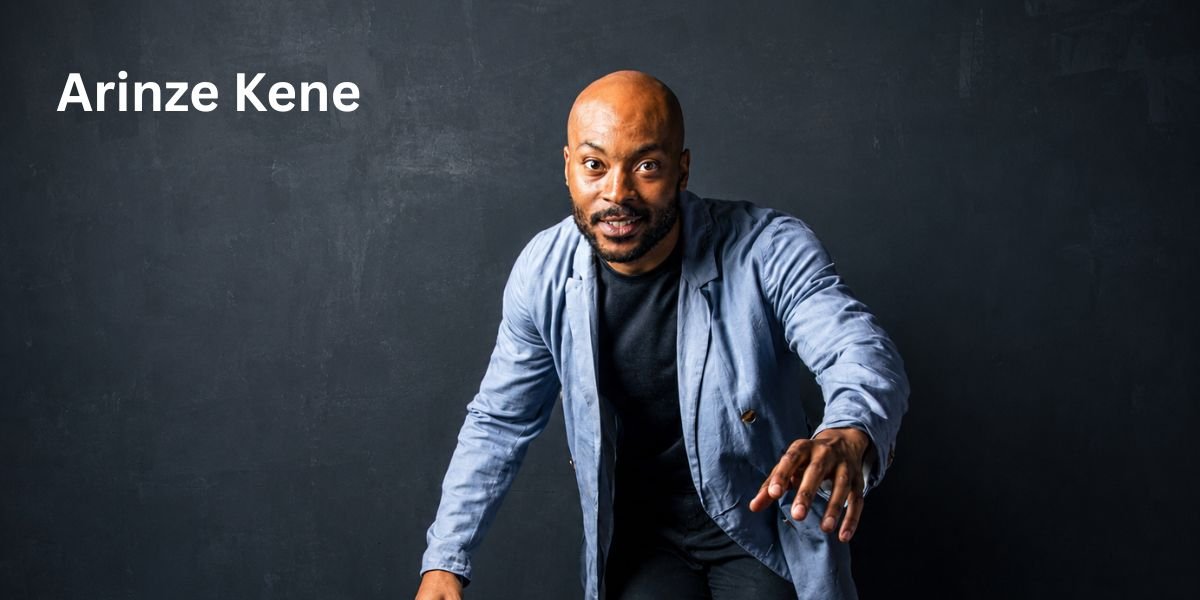
Arinze Kene, professionally styled Arinzé Kene, is one of those creative figures who does not fit neatly into a single category. He is an actor, playwright, performer and storyteller whose career has moved confidently between television, film and some of Britain’s most respected theatre stages. Instead of simply building a reputation through recognizable acting roles, Kene has also developed an individual voice as a writer, particularly through work exploring identity, community, race, masculinity and modern urban life.
Born in Lagos, Nigeria, Kene moved with his family to East London in 1991. His upbringing in London later became an important influence on the way he approached storytelling. Before establishing himself professionally, he participated in the Royal Court Theatre’s Young Writers Programme and Soho Theatre’s HUB writers’ programme, experiences that helped develop the writing side of his career.
What makes Kene particularly interesting is the range of his work. He has appeared in mainstream television and film while simultaneously creating challenging theatre. His critically recognized play Misty became especially important to his reputation, but it represents only one chapter in a career that has included writing, acting, music and live performance.
Who Is Arinze Kene?
Arinzé Kene is a Nigerian-born British actor and playwright whose professional identity has been shaped by both performance and writing. He was born in Lagos in 1987 and grew up in London after his family relocated to the United Kingdom when he was young. Sources including the Black Plays Archive describe him as an award-winning playwright and actor and identify East London as an important part of his background.
The interesting thing about Kene’s career is that he has never seemed interested in choosing between being an actor and being a writer. Many performers eventually move into writing, while many playwrights occasionally perform their own material. Kene has treated the two disciplines as parts of the same creative process. His understanding of how dialogue sounds in a performer’s mouth clearly informs his writing, while his experience as a writer gives him another layer of insight when approaching characters created by someone else.
Music has also played a noticeable role in his artistic development. Accounts of his early career describe him singing with a jazz band before acting became his main professional direction. That musical instinct can still be felt in his theatrical work, particularly in his attention to rhythm, spoken language and the relationship between words and live sound. This helps explain why some of his most distinctive work feels closer to a combination of theatre, poetry and live music than a conventional stage drama.
Arinze Kene’s Early Life and Creative Beginnings
Kene’s childhood stretched across two different cultural environments. He was born in Nigeria before growing up in Hackney, London, an experience that gave him a close relationship with both Nigerian heritage and British urban culture. Interviews with Kene have frequently connected his creative perspective with this combination of influences, particularly when discussing belonging, identity and the social expectations placed on Black British artists.
His entry into the creative industries was not based on a perfectly planned route. According to biographical accounts, he initially studied physiotherapy at university but left the course early and focused on acting. That decision proved significant. Rather than following a predictable academic path into a conventional profession, he committed himself to performance and gradually established a career across different areas of British entertainment.
Writing developed alongside that acting career. Kene took part in the Royal Court Theatre’s Young Writers Programme and Soho Theatre’s HUB programme, both valuable environments for emerging writers interested in developing work for the stage. His early plays included titles such as Estate Walls, Little Baby Jesus, Suffocation and God’s Property. These projects helped establish his reputation as a writer interested in contemporary lives, communities and difficult social questions rather than safe or purely commercial storytelling.
Building a Career as an Actor
Before Arinze Kene became widely discussed for Misty, many audiences already knew his face from television and stage work. His screen career has included appearances in British productions such as EastEnders, Our Girl, Youngers and The Pass. He has also appeared in larger film projects, demonstrating his ability to move from intimate drama to mainstream productions without becoming permanently associated with one particular type of character.
His theatre career has been equally varied. Kene has performed in productions including The Lion King, One Night in Miami and Girl from the North Country. The latter combines drama with the music of Bob Dylan, making it a particularly suitable environment for a performer whose artistic background includes both music and acting. His stage career has repeatedly shown that his abilities extend beyond straightforward dramatic acting into physically and musically demanding performance.
One of his major West End roles came when he portrayed Bob Marley in Get Up, Stand Up! The Bob Marley Musical. The National Theatre’s professional profile for Kene includes this production among his West End work. Playing such a culturally recognizable musician presents a different challenge from creating a fictional character. It requires a performer to capture enough of the real person’s energy to satisfy audiences while avoiding a performance that feels like simple imitation. Kene’s combination of acting and musical experience made the role a logical extension of the abilities he had demonstrated throughout his career.
Why Misty Became Arinze Kene’s Breakthrough Work
If one production best represents Arinze Kene artistic identity, it is probably Misty. Written and performed by Kene, the production originally appeared at London’s Bush Theatre in 2018 before transferring to Trafalgar Studios in the West End after its successful run. The Bush Theatre describes the work as a lyrical journey through inner-city London, combining an original score with Kene’s examination of urban experiences and the pressures surrounding an artist’s identity.
What made Misty stand apart was its refusal to behave like a traditional one-person play. It mixes direct address, spoken word, music, storytelling and self-reflection. At different points, the audience is not simply watching a fictional narrative. It is also watching a writer question the process of creating that narrative and examine what people expect from him as a Black artist. That layered structure gives the work an unusually self-aware quality without stripping away its emotional force.
The play also asks a much larger question about categorization. Does work written by a Black playwright automatically need to represent a particular kind of Black experience? Kene explored that tension directly in writing connected with Misty, questioning why artistic works are sometimes categorized according to the racial identity of their creator while supposedly neutral categories remain available to other writers. That question helped Misty become more than a story about London. It became a discussion about who gets to define art and what responsibilities audiences and industries place on individual artists.
Arinze Kene as a Playwright
Although Misty brought Arinze Kene considerable attention, his writing career began much earlier. The Black Plays Archive lists a substantial body of stage work including Defined by Design, Estate Walls, Little Baby Jesus, Suffocation, God’s Property, Good Dog and Misty. Seeing these titles together makes it clear that Kene’s reputation as a playwright was built gradually rather than emerging overnight from one successful production.
His plays frequently engage with people living inside complicated social systems. Questions surrounding race, family, community, economic pressure, masculinity and belonging appear in different forms throughout his work. Yet reducing Kene’s writing to a checklist of social themes misses something important. His strongest work is interested in how people actually speak, react, joke, contradict themselves and survive difficult circumstances. The political meaning usually emerges through the characters rather than replacing them.
Language is one of his most recognizable strengths. Kene often treats dialogue as something musical, using rhythm, repetition and shifts in pace to create energy. That style makes sense when considered alongside his background in music and performance. His writing is not designed only to look good on the page. It is built to be spoken, heard and physically experienced inside a theatre. That distinction is one reason his work can appeal to audiences who may not normally think of themselves as regular theatre-goers.
Recognition, MBE and Continued Theatre Success
Kene’s contribution to British drama has received formal recognition as well as critical attention. In the 2020 Queen’s Birthday Honours, Arinze Kene Mokwe Kene was appointed a Member of the Order of the British Empire, or MBE, for services to drama and screenwriting. The official UK government honours list records the award specifically in recognition of those areas of his career.
The significance of that recognition becomes clearer when looking at the unusual structure of Kene’s career. He has contributed to screen acting, stage acting and original writing rather than building his reputation entirely within one branch of entertainment. The MBE therefore recognized work that had already reached across several areas of British culture. By that stage, he had demonstrated that commercially visible acting and experimental theatre did not need to exist in completely separate creative worlds.
His theatre career has continued beyond the period surrounding Misty. In 2025, Kene appeared at the National Theatre in Alterations, playing protagonist Walker Holt in a major revival staged at the Lyttelton Theatre from February 20 to April 5. The production further demonstrated his continued connection to major British theatre institutions while placing him inside the legacy of another important Black British theatrical work.
What Makes Arinze Kene Different From Other Performers?
Versatility is an easy word to use when discussing actors, but with Arinze Kene it has a more specific meaning. He is not versatile simply because he can perform several types of roles. His career moves between creative positions. In one project he may interpret another writer’s character, while in another he may create the entire text, perform it himself and help shape how music and language interact on stage.
That movement changes the way audiences can understand his performances. A playwright understands structure, intention and subtext from the perspective of someone who has actually built characters from nothing. Meanwhile, an experienced actor understands which sentences feel natural in performance and which ideas need something more than words to succeed. Kene’s ability to operate from both perspectives gives his work a distinctive quality.
There is also a willingness to experiment that runs through his career. Misty, in particular, demonstrated how spoken word, music, theatre and commentary about the artistic process could exist in one production without needing to fit comfortably into a conventional genre. The Bush Theatre regarded the production as significant enough to transfer it into the West End after its successful original run. For Kene, experimentation has not meant abandoning audiences. Much of his work remains energetic, accessible and entertaining even while addressing complicated ideas.
Arinze Kene’s Influence on Contemporary British Theatre
Kene belongs to a generation of British artists who have challenged assumptions about which stories belong on major stages and how those stories should be told. The importance of Misty was not limited to positive reviews. Bush Theatre leadership described its West End transfer as an important moment for Black British theatre and argued that the production challenged existing ideas about what new British theatre could look like.
His influence can also be seen in the way other theatre-makers have discussed the production years later. In 2024, performer and writer Anoushka Lucas described Misty as a work that significantly affected her understanding of what a solo performance could achieve, particularly because it combined social interrogation, performance and artistic experimentation rather than relying on conventional autobiographical storytelling. That kind of influence matters because an artist’s impact is not measured only by awards or ticket sales. It can also be measured through the new creative possibilities other artists see after encountering the work.
Kene’s broader significance therefore comes from more than representation alone. Representation is certainly relevant to understanding his position within British theatre, but his work is equally important because of its form. He demonstrates that stories about Black British life can be experimental, musical, funny, uncomfortable, political, personal and commercially successful at the same time. That ability to resist simple categorization is arguably one of his most valuable contributions.
The Lasting Appeal of Arinze Kene’s Work
Part of Kene’s appeal comes from his refusal to separate entertainment from serious ideas. Theatre dealing with identity or social tension can sometimes become overly instructional, while purely commercial productions can avoid difficult subjects altogether. Kene often works somewhere between those extremes. His writing can challenge an audience without forgetting that people have come to experience a performance rather than attend a lecture.
His acting career adds another layer to that appeal. Someone who first discovers him through a television drama or film may later encounter Misty or one of his other plays and realize how broad his creative work actually is. Likewise, theatre audiences who know him primarily as a playwright can see him take on material created by other writers. That crossover helps keep his career unpredictable.
Most importantly, Arinze Kene has developed a recognizable creative identity without allowing that identity to become restrictive. His Nigerian roots, East London upbringing, musical background and professional experience all contribute to his work, but none provides a complete definition of him. He remains an artist capable of moving into new territory while carrying the storytelling instincts that have shaped his career from the beginning.
Frequently Asked Questions About Arinze Kene
Who is Arinze Kene?
Arinze Kene, also known as Arinzé Kene, is a Nigerian-born British actor, playwright and performer known for his work in theatre, television and film. He has built a strong reputation through his acting roles as well as his original stage productions, especially the critically acclaimed play Misty. His career is recognized for exploring themes such as identity, community, culture and modern urban experiences.
Beyond acting, Kene is respected as a writer who brings a unique perspective to British theatre. His combination of performance skills, storytelling ability and creative experimentation has made him one of the notable contemporary voices in British drama.
What is Arinze Kene best known for?
Arinze Kene is best known for writing and performing the stage play Misty, which became one of the most talked-about productions in modern British theatre. The play received critical attention for its creative style, combining spoken word, music, storytelling and personal reflection to explore life in London and the experiences of a Black British artist.
He is also recognized for his acting work in productions such as Get Up, Stand Up! The Bob Marley Musical, Girl from the North Country, television dramas and various film projects. His ability to move between writing and acting has helped him develop a distinctive career.
Where was Arinze Kene born?
Arinze Kene was born in Lagos, Nigeria, in 1987. He later moved with his family to East London, where he grew up and developed much of his creative perspective. His experiences between Nigerian heritage and British urban culture have influenced many aspects of his storytelling.
Growing up in London exposed him to diverse communities and everyday experiences that later became important elements in his plays. His background continues to shape the themes and characters found in his creative work.
Is Arinze Kene married?
Arinze Kene keeps his personal life private and has not publicly shared many details about his relationships or family life. Unlike his professional achievements, he generally avoids discussing private matters in interviews and focuses more on his artistic projects.
This privacy allows his public profile to remain centered around his work as an actor, writer and performer rather than his personal affairs.
Has Arinze Kene won any awards?
Yes, Arinze Kene has received recognition for his contributions to drama and screenwriting. In 2020, he was appointed a Member of the Order of the British Empire (MBE) for services to drama and screenwriting.
His work, particularly Misty, has also received significant critical praise and contributed to discussions about the future of British theatre and representation within the performing arts.
Conclusion
Arinze Kene has built a career that demonstrates how powerful it can be when an artist refuses to stay inside a single professional box. As an actor, he has worked across film, television and major theatre productions. As a playwright, he has created an increasingly respected body of work that includes Estate Walls, Little Baby Jesus, God’s Property, Good Dog and the groundbreaking Misty.
His journey from Lagos to East London and eventually to major British stages has given him a perspective that feels both culturally specific and widely relatable. Rather than simplifying questions about identity, race or belonging, Kene’s writing often embraces their contradictions. That complexity helps his work remain interesting because it invites audiences to think without dictating exactly what they should think.