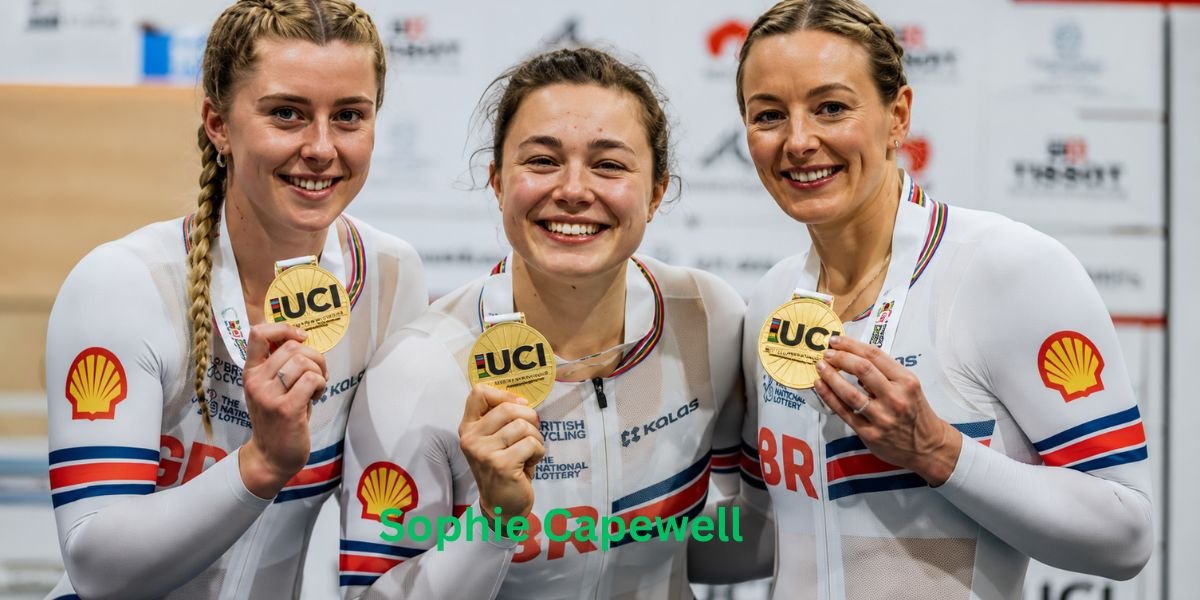
Sophie Capewell has developed into one of the most accomplished and dependable sprint cyclists in British sport. Known for her explosive power, technical control and ability to perform under pressure, the Lichfield-born rider has collected medals at Olympic, World, European and Commonwealth level.
Her career has not followed a perfectly smooth path. Capewell spent years competing at junior and national events before securing a regular place among Great Britain’s elite sprinters. She then had to manage the physical demands of international competition alongside difficult personal circumstances. Those experiences helped shape the resilient athlete who eventually became an Olympic and world champion.
Capewell’s achievements extend beyond a single successful tournament. Her performances between 2021 and 2026 demonstrate steady development across the team sprint, individual sprint, keirin and time-trial disciplines. As of August 2026, she remains an important member of Britain’s world-class track sprint programme and one of the leading figures in women’s cycling.
Who Is Sophie Capewell?
Sophie Ellen Capewell is a British track cyclist who was born on 4 September 1998 in Lichfield, Staffordshire. She specialises in short-distance track events that demand acceleration, tactical awareness and exceptional peak power. These include the individual sprint, team sprint, keirin and time trial.
Although casual sports fans may know her mainly from the Paris 2024 Olympic Games, Capewell had already built a substantial cycling career before becoming an Olympic champion. She competed internationally as a junior, won national titles and gradually established herself in the Great Britain senior squad. Her development shows how success in track cycling is often the result of years of technical work rather than one sudden breakthrough.
Capewell is based in Manchester, where Britain’s leading track cyclists train within the national performance programme. The environment places athletes alongside Olympic and world champions while giving them access to specialist coaching, sports science and race analysis. Competing in such a strong squad can make selection difficult, but it has also helped Capewell develop against some of the fastest riders in the sport.
Sophie Capewell’s Early Life and Introduction to Cycling
Cycling was part of Sophie Capewell’s life from an early age. Her father, Nigel Capewell, represented Great Britain as a Paralympic cyclist at the Atlanta 1996 and Sydney 2000 Games. His sporting background gave Sophie a close view of elite competition, although she still had to build her own identity and earn her own opportunities within the sport.
Capewell began her journey with Lichfield City Cycling Club, initially attending Go-Ride sessions designed to introduce young riders to the sport. She explored several forms of cycling, including circuit racing, mountain biking and cyclo-cross. Trying different disciplines allowed her to develop general bike-handling skills before she became more focused on track sprinting.
Her early experiences also show why local cycling clubs remain important to the British performance system. Before athletes enter national academies or compete in packed velodromes, they normally begin at community sessions where they learn basic skills and discover which events suit them. In Capewell’s case, that pathway eventually revealed a rider particularly suited to the speed, precision and intensity of track sprinting.
Building a Career Through Junior Competition
Capewell made her Great Britain debut at the 2015 UEC Under-23 and Junior European Track Championships in Athens. She narrowly missed the podium during that competition, recording several fourth- and fifth-place finishes. Although she returned without a medal, competing against Europe’s strongest young riders provided valuable experience at a relatively early stage of her career.
Her first major international medals arrived one year later at the 2016 Junior European Track Championships in Montichiari. Capewell won bronze in both the 500-metre time trial and team sprint. She also moved into the Great Britain Cycling Team Senior Academy during 2016, confirming that coaches considered her one of the country’s most promising sprint prospects.
National competition played an equally important role in her development. Capewell collected titles in events such as the keirin, sprint and team sprint while learning how to deliver several high-intensity performances across the same championship. Track sprinters may race repeatedly through qualifying rounds, knockout heats and finals, so recovery and consistency are nearly as important as raw speed.
Breaking Through at Senior International Level
Capewell made her elite World Championship debut at the 2020 UCI Track World Championships in Berlin. Reaching that level represented a major step, but her first senior world medal did not arrive until 2021. At the World Championships in Roubaix, she helped Great Britain secure bronze in the women’s team sprint.
She returned to the World Championship podium in 2022, again winning team sprint bronze. These consecutive medals established Capewell as a reliable member of Britain’s sprint unit. Team sprint success depends on precise exchanges of responsibility, with each rider leading a lap before moving aside. A small technical error can cost several tenths of a second, making trust and timing essential.
Capewell continued that progress at the 2023 UCI Cycling World Championships in Glasgow. She qualified second-fastest in the individual sprint with a personal-best time of 10.309 seconds and reached the quarter-finals. She also helped Great Britain win silver in the team sprint, giving her a third consecutive World Championship medal in that event.
Commonwealth Games Success and Personal Resilience
The Birmingham 2022 Commonwealth Games gave Capewell an opportunity to represent England in front of a home crowd. She recovered from a difficult opening to win bronze in the 500-metre time trial and silver in the keirin. Those medals introduced her to a wider audience and demonstrated that she could compete successfully in individual events as well as the team sprint.
The results carried considerable emotional significance. Capewell’s father had passed away after a long illness in 2021, during the same period in which she won her first senior World Championship medal. She later dedicated her Birmingham medals to him and spoke openly about the challenge of balancing elite training with time spent supporting her family.
Rather than presenting grief as something that disappeared once she returned to competition, Capewell has discussed it as a complicated experience that remained part of her sporting journey. That honesty has added depth to her public profile. Her resilience is not simply about winning after hardship; it is also visible in her willingness to acknowledge the difficult decisions and emotions that athletes may face away from competition.
Sophie Capewell’s Historic Paris 2024 Olympic Gold
The defining moment of Sophie Capewell’s career arrived at the Paris 2024 Olympic Games. Racing with Katy Marchant and Emma Finucane, she helped Great Britain win the women’s team sprint gold medal. It was Britain’s first Olympic title in the event, achieved after the country had not qualified a women’s team sprint squad for the Games since 2012.
The British trio did not simply win the final. They broke the world record three times during the competition. After setting a record in qualifying, they lowered their time again in the first round and produced another world-best performance of 45.186 seconds to defeat New Zealand in the gold-medal race. Their final average speed was close to 60 kilometres per hour.
Capewell was responsible for the middle lap of the British formation, connecting Marchant’s opening acceleration with Finucane’s finishing speed. That position requires a rider to handle the transition from a standing-start specialist while maintaining enough momentum for the final rider. Individually, Capewell also finished fifth in the Olympic sprint, confirming that her Paris performance was not limited to the team event.
Becoming a World Champion in 2024
Capewell carried her Olympic form into the 2024 UCI Track World Championships in Copenhagen. Alongside Marchant and Finucane, she won the women’s team sprint world title. The result made them the first women’s squad to claim Olympic and World Championship team sprint titles in the same year.
Her individual performance in Copenhagen was equally significant. Capewell won silver in the women’s 500-metre time trial, recording 33.010 seconds in the final. The ride broke her own British record and delivered the first individual World Championship medal of her senior career. Katy Marchant took bronze, giving Britain two places on the podium.
This result added another dimension to Capewell’s reputation. Before Copenhagen, most of her senior world medals had come from the team sprint. Winning an individual time-trial medal showed that she could produce a complete performance without relying on tactical positioning or teammates. It was a direct test of acceleration, pacing and the ability to tolerate an intense physical effort to the finish.
Continuing to Compete at the Highest Level in 2026
Capewell remained a major international contender after her Olympic and world titles. At the 2026 European Track Championships in Konya, she contributed to Great Britain’s silver medal in the women’s team sprint. The British squad missed gold to Germany by only 0.003 seconds, illustrating how narrow the margins can be at elite level.
She also reached the individual sprint final at the same European Championships. After defeating Germany’s Lea Sophie Friedrich in the semi-final, Capewell faced British teammate Emma Finucane in an all-GB contest for gold. Finucane won the final, while Capewell collected another European silver medal. Capewell also finished fourth in the newly extended women’s one-kilometre time trial.
At the Glasgow 2026 Commonwealth Games, Capewell added two more silver medals to her record. She joined Katy Marchant and Rhianna Parris-Smith in England’s second-place team sprint squad before taking silver in the individual sprint. These results expanded a Commonwealth collection that already included keirin silver and time-trial bronze from Birmingham 2022.
Racing Style, Power and Tactical Intelligence
Capewell’s success is built around a combination of physical power and technical discipline. Track sprint races are short, but they are not simple. Riders must choose appropriate gears, control their position on steep banking and judge exactly when to accelerate. In the individual sprint, tactical decisions made at low speed can determine what happens when the race suddenly reaches maximum intensity.
Her results across several events suggest that versatility is one of her strongest qualities. The team sprint rewards accurate execution within a fixed structure, while the individual sprint can become a tactical contest. The keirin requires riders to react in a crowded, fast-moving group, and the time trial removes tactics almost entirely. Capewell has reached international podiums in each of these formats.
She has also shown an ability to respond positively after disappointment. At the 2024 World Championships, she described turning her frustration from the previous day into energy for the 500-metre time trial. She then broke the national record and won silver. That response reflects an important element of elite performance: athletes must process one result quickly because another medal opportunity may arrive within hours.
Life Away from the Velodrome
Away from competition, Capewell is known for her interest in photography. It provides a contrast to the highly controlled world of elite sport, where training sessions are measured through times, power outputs and carefully planned workloads. Photography gives her a more creative activity outside the constant evaluation associated with professional cycling.
She also advocates for greater participation among women and girls in cycling. Part of that work involves improving understanding of how the menstrual cycle can affect women in sport. Discussions of female physiology were historically overlooked in many training environments, so experienced athletes who speak publicly about the subject can help make coaching and participation more inclusive.
Following her Olympic success, Capewell was appointed a Member of the Order of the British Empire in the 2025 New Year Honours for services to cycling. The recognition reflected both the importance of her Paris achievement and her contribution to British sport more broadly.
Why Sophie Capewell Matters to British Cycling
Sophie Capewell belongs to a generation that has transformed Britain’s women’s sprint programme. For several years, Britain was better known for success in endurance disciplines such as the team pursuit. The Olympic victory achieved by Capewell, Marchant and Finucane demonstrated that the country had also developed a world-leading women’s sprint system.
Her story is particularly valuable because it shows the amount of work that comes before an Olympic breakthrough. Capewell was not an overnight success. She progressed from local club sessions to junior championships, national titles, senior selection and repeated international podiums. By the time she won in Paris, she had already spent close to a decade competing within the British pathway.
She also provides an example of how an athlete can become more than a list of results. Her openness about loss, her support for women in sport and her interest in life beyond cycling make her relatable without reducing the seriousness of her achievements. She is an Sophie Capewell champion, but she is also someone whose career has required patience, adjustment and emotional resilience.
What Could Come Next for Sophie Capewell?
Capewell was 27 during the 2026 season, an age at which many track sprinters remain capable of improving. Sprint cycling rewards experience because tactical judgement, technical efficiency and confidence can continue developing even after an athlete has reached physical maturity. Her recent European and Commonwealth medals indicate that she remains competitive against the strongest riders in the sport.
The Los Angeles 2028 Olympic Games represent an obvious long-term target. Defending an Olympic team sprint title would be difficult, particularly as other nations continue investing in their women’s sprint programmes. Britain will also face intense internal competition because several younger riders are progressing through the national system.
Individual medals are another realistic ambition. Sophie Capewell has already reached a World Championship time-trial podium, a European sprint final and the top five of an Olympic sprint competition. Turning those performances into an individual world or Olympic title would add another major chapter to an already impressive career.
Frequently Asked Questions About Sophie Capewell
Who is Sophie Capewell?
Sophie Capewell is a British track cyclist known for competing in sprint events such as the team sprint, individual sprint, keirin and time trial. Born in Lichfield, Staffordshire, she became one of Britain’s leading female sprinters through years of national and international competition.
She gained worldwide attention after Sophie Capewell Olympic gold in the women’s team sprint at the Paris 2024 Olympic Games with Katy Marchant and Emma Finucane. The British team also broke the world record multiple times during the competition, making the achievement one of the biggest moments in British track cycling history.
What medals has Sophie Capewell won?
Sophie Capewell has won medals at Olympic, World Championship, European Championship and Commonwealth level. Her biggest achievement came at the Paris 2024 Olympics, where she won gold in the women’s team sprint.
She has also won World Championship gold in the team sprint, World Championship silver in the 500-metre time trial, and multiple medals at Commonwealth and European competitions. Her medal record highlights her ability to compete successfully in both team and individual sprint events.
How old is Sophie Capewell?
Sophie Capewell was born on 4 September 1998, making her 27 years old during the 2026 cycling season. She reached elite international level at a relatively young age and has continued improving through experience, competition and years of professional training.
Unlike some athletes who achieve success immediately, Sophie Capewell developed gradually through junior competitions, national championships and the British Cycling performance pathway before becoming an Olympic champion.
What event does Sophie Capewell compete in?
Sophie Capewell mainly competes in track cycling sprint events. Her specialist disciplines include the team sprint, individual sprint, keirin and 500-metre time trial.
Each event requires different skills. The team sprint focuses on teamwork and perfect timing, while individual sprint events require tactical decisions, speed control and the ability to produce maximum power at the right moment.
Did Sophie Capewell win gold at the Paris 2024 Olympics?
Yes, Sophie Capewell won Olympic gold in the women’s team sprint at the Paris 2024 Olympic Games. She competed alongside Katy Marchant and Emma Finucane as part of the Great Britain team.
The trio made history by winning Britain’s first Olympic gold medal in the women’s team sprint. Their performance was even more impressive because they broke the world record three times during the competition.
Who are Sophie Capewell’s teammates in the Olympic team sprint?
At the Paris 2024 Olympics, Sophie Capewell’s teammates in the women’s team sprint were Katy Marchant and Emma Finucane.
The three riders combined their different strengths to create one of the fastest sprint teams in the world. Marchant provided a powerful start, Capewell delivered the middle section and Finucane completed the final lap with explosive speed.
Is Sophie Capewell related to a cyclist?
Yes, Sophie Capewell comes from a cycling family. Her father, Nigel Capewell, was also a competitive cyclist who represented Great Britain at the Paralympic Games.
Growing up around cycling helped Sophie understand the dedication required in elite sport, although she built her own career through her personal achievements and performances.
Conclusion
Sophie Capewell has earned her position among Britain’s leading track cyclists through consistent development, technical excellence and resilience. From junior European medals to Olympic gold, her career illustrates how elite success is constructed over many seasons rather than created in a single race.
Her Paris 2024 victory will remain the result most closely associated with her name. Breaking the world record three times and winning Britain’s first Olympic women’s team sprint title was an extraordinary achievement. Becoming a world champion and individual World Championship medallist later that year proved that the Olympic result was part of a wider period of excellence.