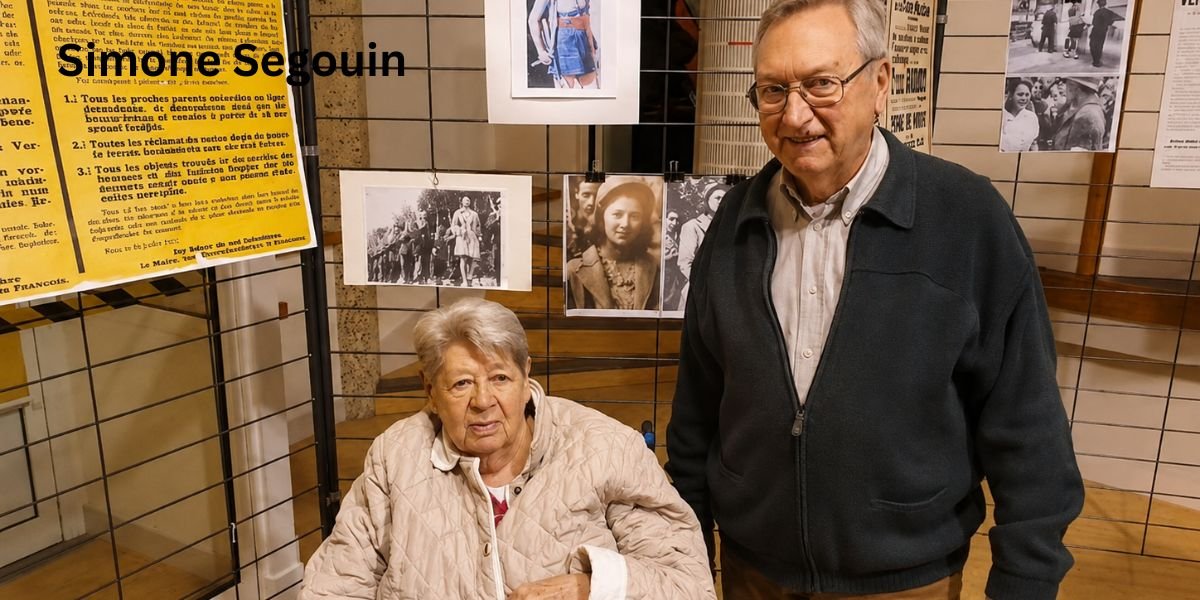
Simone Segouin historical figures become famous because they held powerful positions or commanded armies. Others are remembered because, at a critical moment, they chose to act. Simone Segouin belongs firmly in the second group. She was still a teenager when she became involved in the French Resistance during World War II, yet her age did not prevent her from taking on serious responsibilities during the German occupation of France.
Known within the Resistance by the name Nicole Minet, Segouin worked with the Francs-Tireurs et Partisans, commonly called the FTP. She began with duties such as carrying messages and gradually became involved in more demanding Resistance operations. Her experiences eventually placed her among the best-known young women associated with the liberation of France.
Her story gained international attention partly because photographer Robert Capa captured memorable images of her during the liberation period in 1944. Those photographs showed a young French woman standing confidently among Resistance fighters at a moment when France was emerging from years of occupation. Yet Simone Segouin’s life was far more interesting than a single famous photograph. She lived until the age of 97, carrying the experiences of the Resistance with her for nearly eight decades after the war.
Who Was Simone Segouin?
Simone Segouin was a French Resistance fighter born on October 3, 1925, in Thivars, a village near Chartres in the Eure-et-Loir department of France. She grew up in a farming family with three brothers. Her childhood was therefore quite different from the dramatic wartime image through which much of the world later came to know her. Before becoming involved in the Resistance, she lived the relatively ordinary life of a young woman in rural France.
Her life changed dramatically because of World War II and the occupation of France. For many French families, occupation was not something happening far away on a battlefield. German forces were present in towns and villages, restrictions affected everyday life, and people constantly had to decide how they would respond. Some cooperated with the occupying authorities, some simply tried to survive, and others became involved in organized resistance.
Segouin chose resistance. During the final phase of the occupation, she became associated with the Francs-Tireurs et Partisans, an important armed Resistance organization. She operated under the false identity Nicole Minet, which helped separate her Resistance activities from her real identity. According to accounts of her life, the documents supporting that identity described Nicole Minet as being from Dunkirk, where wartime destruction made verification more difficult.
What makes her story especially striking is how young she was. She was about 18 when she became deeply involved in Resistance activity in 1944. Rather than being treated only as an observer, Segouin was trusted with responsibilities that supported the wider Resistance network. Over time, she moved from communication and support tasks toward more direct participation in operations carried out by her group.
Simone Segouin’s Early Life and the Impact of German Occupation
Before World War II transformed France, Simone’s world largely revolved around her family and their farm. She left school relatively young and worked with her family. Rural life required practical skills and physical work, characteristics that may have helped her adapt to the difficult conditions she later encountered during the Resistance. Her upbringing was not one that obviously pointed toward international recognition or wartime fame.
Her father was also an important influence. Historical accounts describe him as someone with military experience and connections to Resistance activity. Simone later spoke with respect about his involvement. Growing up in a household where patriotism and opposition to the occupation were taken seriously likely shaped the way she viewed what was happening around her.
German occupation placed French civilians in extraordinarily complicated situations. Decisions that would normally have seemed simple could suddenly carry serious consequences. Young people faced forced labor pressures, families dealt with shortages and restrictions, and Resistance organizations operated secretly because discovery could result in arrest.
For Simone, remaining completely outside the conflict became increasingly difficult. Accounts from France describe an episode in which German authorities wanted local young women for work connected with their presence in the area. Her father feared the situation could endanger the family and Resistance connections, contributing to Simone’s departure from home and eventual entry into the local Resistance movement.
The transition was remarkable. Within a relatively short period, the young farm worker became Nicole Minet, a member of an underground organization operating in occupied territory. It required her to accept a new identity while learning how to function in an environment where information had to be protected and trust mattered enormously.
How Simone Segouin Joined the French Resistance
Segouin’s entry into the Resistance connected her with Roland Boursier, generally identified by his Resistance role as Lieutenant Roland. He introduced her to members of the organization and helped prepare her for the responsibilities she would take on. From that point forward, the difference between her civilian identity and her Resistance identity became increasingly important.
Her early work included serving as a liaison or messenger. That role might sound less dramatic than combat, but communication was essential to underground movements. Resistance groups depended on people who could move between locations while carrying information and maintaining secrecy. Segouin traveled within the Eure-et-Loir area while carrying messages and supporting the network.
One of the best-known stories from this period concerns a bicycle. Segouin obtained a bicycle belonging to a German courier and used it afterward for Resistance work. The bicycle reportedly became an important means of transportation as she carried out liaison duties. The episode has often been repeated because it captures something important about Resistance activity: everyday objects could become surprisingly valuable when organized networks lacked normal resources.
As Segouin gained experience, her responsibilities expanded. Accounts of her wartime service associate her with sabotage activities, operations against German forces and actions involving railway infrastructure. These were part of the wider Resistance effort to disrupt occupation forces and support the liberation campaign as Allied armies advanced through France.
Segouin was unusual partly because relatively few women in Resistance organizations were publicly associated with armed roles. Women were essential throughout the French Resistance as couriers, intelligence gatherers, organizers, shelter providers and underground activists, but their contributions were sometimes minimized in post-war accounts. Segouin’s visible presence during liberation helped make her one of the recognizable female faces of the movement.
Simone Segouin and the Liberation of Chartres
The summer of 1944 changed the direction of the war in Western Europe. Following the Allied landings in Normandy on June 6, German forces increasingly faced pressure as Allied armies moved deeper into France and Resistance groups intensified their activities. Chartres and the surrounding area became part of this rapidly changing military and political landscape.
Simone Segouin participated in Resistance activity connected with the liberation of Chartres in August 1944. Chartres was liberated as German control collapsed across parts of northern France. Segouin’s presence during these events was significant not simply because she was young, but because she had already spent months contributing to the underground network that helped prepare for liberation.
Accounts of her wartime experience also connect her Resistance group with the capture of a group of German soldiers during the liberation period. Different later retellings give slightly different numbers, which is why it is more accurate to describe the episode as involving more than twenty German soldiers rather than treating one specific figure as unquestionable.
Segouin also traveled with Resistance comrades toward Paris during the liberation period. Paris was liberated in late August 1944 following an uprising, Resistance activity and the arrival of French and Allied forces. Some popular accounts loosely describe Segouin as directly fighting in the liberation of Paris, although more detailed French accounts make a distinction between traveling there with her group and taking part personally in the main street fighting.
That distinction matters because Segouin’s real accomplishments do not need exaggeration. Her involvement in the Resistance and the liberation of the Chartres area was already significant. Treating historical figures accurately makes their achievements more meaningful, not less.
The Famous Robert Capa Photographs of Simone Segouin
Many people who recognize Simone Segouin today probably know her first through photographs rather than written history. During the liberation of France, legendary war photographer Robert Capa photographed the young Resistance fighter. His images contributed enormously to her international recognition.
Capa’s photographs appeared in connection with American coverage of the liberation, while journalist Jack Belden wrote about Segouin for Life magazine in a piece titled “The Girl Partisan of Chartres.” The combination of journalism and photography introduced American readers to an image of the French Resistance that was immediate and personal: instead of seeing only armies and political leaders, readers encountered a young woman who had participated directly in her country’s struggle against occupation.
The photographs became historically powerful because of the contrast they presented. Segouin looked extremely young, yet she stood among experienced Resistance fighters during one of the most dramatic moments in modern French history. Her appearance challenged traditional assumptions about who participated in wartime resistance.
There is also an important historical lesson in looking beyond the photograph. Famous wartime images can simplify complicated lives. A viewer might see Segouin only as “the girl with a gun,” while missing the months she spent working as a liaison, using a false identity, transporting messages and participating in an underground organization.
That broader perspective reveals why she mattered. Her story represents not merely individual bravery but also the thousands of less-famous Resistance members whose daily work made organized opposition possible. The photograph gave Segouin a face known around the world, but her actual contribution began long before the camera arrived.
Simone Segouin’s Life After World War II
When the war ended, Simone Segouin was still remarkably young. Unlike many famous wartime personalities, she did not spend the rest of her life trying to turn her Resistance reputation into celebrity. Instead, she entered a very different profession and built a civilian life.
Segouin trained for healthcare work and became a pediatric nurse. It is one of the most interesting contrasts in her biography. During wartime, she had operated within an underground resistance organization. In peacetime, she devoted herself to caring for children.
France formally recognized her wartime service. She received the Croix de Guerre, one of France’s important military decorations for wartime bravery and service, and was given the rank of second lieutenant in recognition of her Resistance work. These honors demonstrated that her contribution was not simply a story created later by magazines or photographers; French authorities officially recognized her service.
Segouin later lived in Courville-sur-Eure. The local community continued to remember her contribution, and a street was named after her. Such recognition is significant because historical memory often begins locally. National histories discuss major battles and leaders, while towns and villages preserve the names of people whose actions directly affected their communities.
She also had six children and maintained a relatively private life compared with the attention her wartime photographs received. Even as historians and journalists periodically returned to her story, Segouin remained strongly associated with the straightforward belief that she had simply done what circumstances required of her as a French citizen facing occupation.
Why Simone Segouin Remains an Important Historical Figure
Simone Segouin matters because her life gives us a more personal way of understanding the French Resistance. Large historical events can easily become collections of dates, military movements and political decisions. Individual stories remind us that those events were actually experienced by ordinary people who had to make extraordinary choices.
Her story is especially valuable when examining women’s participation in resistance movements. Women performed essential work throughout occupied France, but conventional histories often focused heavily on male soldiers, commanders and political leaders. Segouin became an unusually visible example of a woman whose Resistance activity moved beyond support work into increasingly active operations.
At the same time, historians should avoid turning her into an unrealistic action-movie character. What makes her remarkable is precisely that she was a real young woman working inside a complicated underground movement. Her effectiveness came from communication, discipline, adaptability and cooperation with others rather than from the exaggerated individual heroics that sometimes appear in modern retellings.
Her famous photographs have helped keep her memory alive, but they also offer a useful reminder about historical interpretation. One image can become symbolic of an entire movement, even though the reality behind that image is much larger. Segouin represented courage, but she also represented the countless couriers, organizers, workers and local fighters who contributed to liberation without becoming internationally famous.
Perhaps the strongest element of her legacy is how simply she seemed to view her actions. Later accounts show little interest on her part in presenting herself as an extraordinary celebrity. Her reasoning was grounded in the circumstances of occupation: France had been occupied, the occupying forces were the enemy, and she believed resistance was necessary.
Simone Segouin’s Death and Lasting Legacy
Simone Segouin lived long enough to see the world change dramatically from the one she had known as an 18-year-old Resistance fighter. She survived the war, built a career, raised a family and watched the events of 1944 become part of history studied by generations born decades later.
She died on February 21, 2023, at the age of 97 in Courville-sur-Eure, France. News of her death received international attention because she had become one of the recognizable surviving figures of the wartime French Resistance.
Her death also demonstrated the extraordinary distance between living memory and recorded history. During much of Segouin’s life, World War II was not simply something found in textbooks. It was an event she personally remembered. People like her provided a direct connection to experiences that are increasingly available only through documents, recordings, photographs and historical research.
Yet Simone Segouin left behind unusually powerful visual evidence of her younger self. Robert Capa’s images ensure that future generations can look directly into the face of someone who participated in the Resistance during the liberation of France. Behind those photographs stands a much longer story: a farm girl from Thivars who became Nicole Minet, carried messages for an underground network, participated in Resistance operations and witnessed the collapse of German occupation in her region.
That is why interest in Simone Segouin continues. She was not a general, national political leader or professional soldier. She was a young civilian who found herself living through extraordinary circumstances and chose to become involved. Her biography shows how history is often shaped not only by famous leaders but also by ordinary people willing to accept responsibility when circumstances demand it.
Frequently Asked Questions About Simone Segouin
Who was Simone Segouin?
Simone Segouin was a French Resistance fighter who became known for her role in opposing German occupation during World War II. She joined the Resistance as a teenager and operated under the name Nicole Minet. Her wartime activities and famous photographs later made her one of the most recognizable female figures of the French Resistance.
What was Simone Segouin’s Resistance name?
Simone Segouin used the Resistance name Nicole Minet. Using an assumed identity helped protect her real identity while she carried out underground activities. False names and identification papers were commonly used by members of Resistance networks because secrecy was essential for avoiding detection.
How old was Simone Segouin when she joined the French Resistance?
Simone Segouin became actively involved in the French Resistance when she was around 18 years old. Despite her young age, she carried messages, supported Resistance operations and later participated in more demanding activities during the liberation of France.
What did Simone Segouin do during World War II?
During World War II, Simone Segouin worked as a courier and Resistance fighter with the Francs-Tireurs et Partisans. She transported messages, supported underground operations and took part in activities connected with the liberation of the Chartres region in 1944.
Why is Simone Segouin famous?
Simone Segouin became internationally famous partly because war photographer Robert Capa photographed her during the liberation of France. The images showed a young female Resistance fighter during a historic moment and later became closely associated with the courage of French Resistance members.
Did Simone Segouin receive any military honors?
Yes. Simone Segouin received the Croix de Guerre in recognition of her wartime service. She was also recognized with the rank of second lieutenant. These honors reflected the importance of her contribution to the French Resistance during World War II.
What did Simone Segouin do after the war?
After World War II, Simone Segouin trained and worked as a pediatric nurse. Rather than building a public career around her wartime fame, she lived a comparatively private life, raised a family and continued to be remembered for her Resistance service.
When did Simone Segouin die?
Simone Segouin died on February 21, 2023, in Courville-sur-Eure, France. She was 97 years old. Her death attracted renewed attention to her remarkable wartime story and her place in the history of the French Resistance.
Conclusion
Simone Segouin remains one of the most recognizable young women associated with the French Resistance during World War II. Born in rural France in 1925, she went from working on her family’s farm to operating under the name Nicole Minet within the Francs-Tireurs et Partisans. She carried messages, supported underground operations and participated in Resistance activity during the liberation of the Chartres region.
Her story became internationally known through Robert Capa’s photographs and contemporary reporting, but focusing only on those famous images would miss the most important part of her biography. Segouin’s contribution came from months of dangerous, disciplined work within an organized resistance network. The photographs recorded a moment; her actions created the story behind that moment.